CRiCL is home to innovative research on memory, attention, perception, and stress. Led by three faculty researchers, the lab provides opportunities for students to engage in hands-on studies that deepen our understanding of the human mind and behavior.
To participate you will need a participant account with our research scheduling system (SONA). Please click on the link to submit your request.
To join the lab as a graduate student or an undergraduate research project assistant complete the form linked above and submit your interest.

Memory, Reasoning, and Symbolic Cognition
Research in the Memory, Reasoning, and Symbolic Cognition (MeReSC) group is led by Dr. M. E. Aktunc. Experiments employing various methodologies focus on reasoning, working memory, semantic memory, and symbolic cognition. Recent studies have investigated the processing of visually presented words, icons, and symbols in recognition and sentence verification tasks. Further experiments are planned to include eye tracking data, in addition to response times and performance accuracy, to shed further light on how symbols, icons, and words are processed in working memory and stored in semantic memory.
Attention & Eye Tracking
Dr. Jacquelyn Berry studies attention, cognition and perception using traditional cognitive science techniques and paradigms coupled with eye-tracking. Attention is her particular focus as she studies how measures of eye movements can be linked to ability in attentional control. Her current work focuses on the gamified versions of the Stroop, Flanker, and Simon, or “3-squared” tasks, which adds additional components requiring inhibitory control, and a scoring component, to better assess individual differences in attentional control.

Stress and Cognition
The research in Dr. Alicia Walf’s lab is focused on how stress impacts cognition. Stress is measured by changes in hormones, physiology, and behavior. Particular areas of focus are on attention, memory, emotions, and social interactions during developmental transitions marked by changes in hormones and neural plasticity, such as adolescence.
Projects
Recognition Memory and Sentence Verification (Dr. Aktunc): In this study, we investigate how simple visual stimuli conveying meaning are cognitively processed by humans.
Attentional Control (Dr. Berry): In this study we have participants complete a series of basic stimulus identification tasks such as identifying arrow direction, text color, and discriminating between similar letters. In this study we also track participant eye-movements as they view simple stimuli on screen.
Technology-enabled Social Buffering (Dr. Walf): In this three-part study, we are looking to observe the potential moderating effects of social interactions via technology on the relationship between stress and attention performance in different tasks. By using the Socially Evaluated Cold Pressor Test as our way of inducing acute stress, we can observe a variety of changes in the body and mind. These changes and differences are measured by perceived scores of mood, anxiety, and stress, concentrations of cortisol and oxytocin, and performance in attention tasks.
Anxiety and Working Memory (Dr. Walf): In this study, we aim to generate a model of how anxiety impacts working memory performance. Here, we use the n-back task and we measure performance by accuracy, false alarm rate, and reaction time. We are also looking to see if sex or gender has any moderating effects on this interaction. Anxiety can be measured in two different ways (cognitive and somatic) at two different points in time (state and trait).
Friends and Fear (Dr. Walf): In this upcoming study, we are looking into whether or not the presence of a partner can reduce the feeling and/or the response of fear in an individual. Future experiments will involve measuring sympathetic nervous system activity over the course of the trial.
Equipment
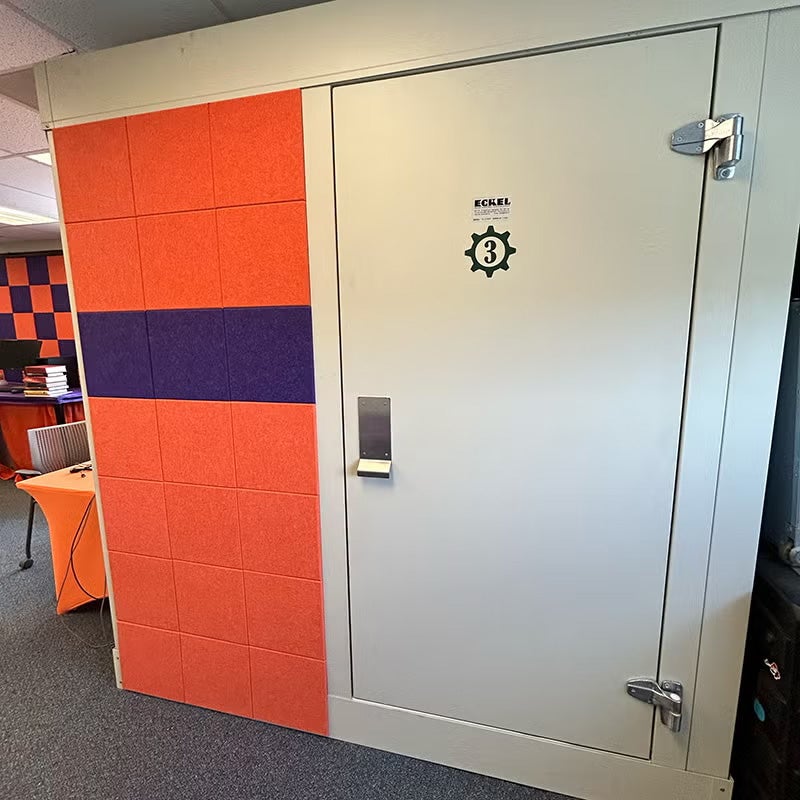
Research Pods
The lab has 4 Eckel CL-14 single-wall, modular audiometric testing rooms. These are engineered by Eckel Noise Control Technologies and widely used by audiologists, hospitals, and private practices. The state-of-the-art acoustic pods are officially graded for laboratory research. Their lab-grade status is verified through certified compliance with international acoustic standards and specific panel performance tiers.
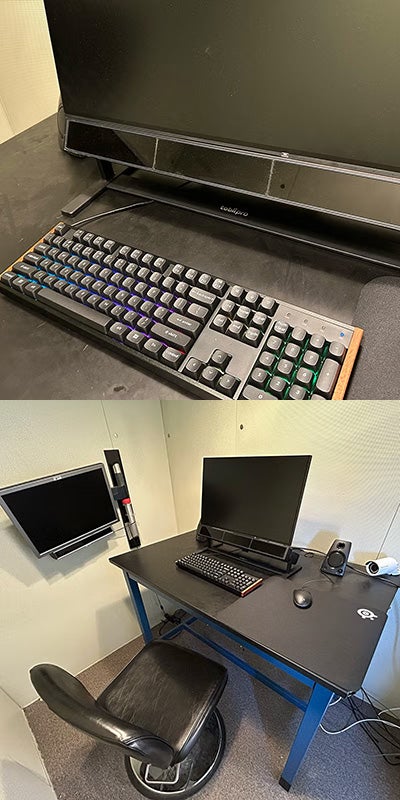
Tobii spectrum eye-trackers
The lab has 4 Tobii spectrum eye trackers. Their most powerful eye tracking system; a screen-based eye tracker designed for intensive scientific research, from fixation-based studies to micro-saccades. Designed for intensive research into human behavior and the mechanics of the fastest eye movements. The system captures data at multiple sampling rates of up to 600 Hz while still allowing for natural head movement.
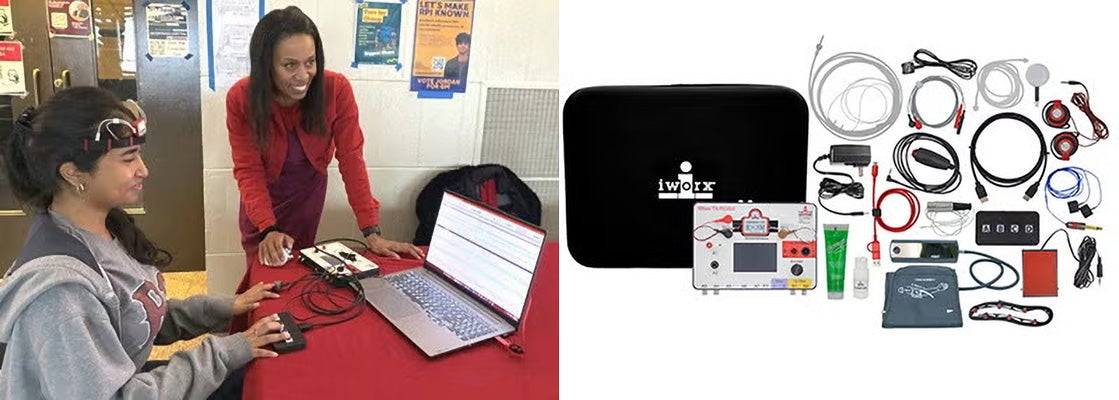
IWorx Psychophysiological Research Equipment -
The CriCL lab uses the PK-TR ROAM Physiological Psychology Lab Kit with Wireless EEG/ECG - The PK-TR ROAM Physiological Psychology Lab Kit includes all of the necessary hardware and components, LabScribe software and expertly written, customizable, lab manuals to teach over 150 exercises in biopsychology, neuroscience, cardiovascular, respiratory, and neuromuscular physiology. Simultaneously record EEGs from the left and right hemispheres, as well as EMGs, respiration rate, heart rate, biofeedback, blood pressure pulse volume, or skin conductance and temperature. Set up is quick, easy, and student friendly with the new, built-in, pre-calibrated sensors of the TR.
Features
- Low Noise Wireless EEG/ECG/EMG
- GSR (Lie Detector)
- Experiment Builder
- Emotion Intensity Meter
- Multi-Sensory Reflexes Sensors
- ECG Simulator, Arrhythmia Generator
- LCD Display, Audio Output
- Student Research Ready
- Bipolar Human Stimulator
- Pulse-Ox, Temperature, Accelerometer