TROY SAVINGS BANK MUSIC HALL
November 19, 2026, 7:30
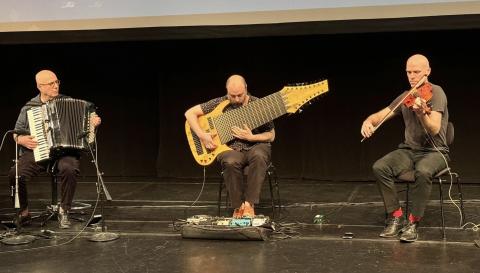
THE ANTIPHON TRIO
Michael Century, Accordion & Electronics
Chris Fisher-Lochhead, Viola & Pedal Steel
Zach Layton, 17-String Bass
With Danny Fisher-Lochhead
CHRONOLUCENCE: ALBUM LAUNCH AND LIVE PERFORMANCE
This performance marks the launch of Chronolucence, the culmination of years of practice-led research, technological development, and collaborative improvisational listening. The Antiphon Trio brings together an unusual electro-acoustic instrumentation - accordion, 17-string bass, viola, and pedal steel guitar - and interfaces it with the Expanded Instrument System (EIS), developed over a 50-year period by Pauline Oliveros, and used by permission of the Pauline Oliveros Trust.
PERFORMING WITH TIME
With EIS, we do not perform in time; we perform with time.
Too often, we seek to command the present moment with immediate, absolute precision. But the present is an illusion of control. To truly listen, we must embrace the delay. Through the Expanded Instrument System, we invite you to experience the radical potential of asynchronous sound. This is not a concert of fixed artifacts, but an evolving process where human intention, algorithmic processing, and the dynamics of the space itself co-create the music you hear.
This is the aesthetics of delay. When the acoustic sounds of the accordion, 17-string bass, pedal steel guitar and viola enter the system, they are captured, transformed, and staggered over elastic temporal spans. The past does not disappear; it returns, altered, circulating through the present and overlapping with the future we are actively anticipating. As Oliveros observed, “What I play in the present comes back in the future while I am still playing, is transformed and becomes a part of the past.”
By dissolving the linear, extractive flow of everyday time, the music demands a continuous, rigorous act of Deep Listening. It suggests that we abandon the myth of synchronization, requiring us instead to balance focused awareness with a global receptivity to the unfolding unknown.
Welcome to the Oliveros time machine. We are not here to master time, but to expand it. Listen closely to the past as it meets you in the future.
THE MUSIC OF CHRONOLUCENCE
The Geologic and Astronomic
(Massif, Scree, Moraine, Sun Streak)
Here, sound behaves like slow earth processes and celestial arcs. Just as a glacier deposits massive ridges of rock over centuries (Moraine) or cliff faces fracture into tumbling stone (Scree), the delay network allows sustained tones to accumulate into tectonic masses of sound (Massif), pierced by sudden flares of acoustic light (Sun Streak).
The Mythic and Deep Time
(Alter Klang, Orphic Idyll, Persephone’s Descent, Widening Gyre)
Time in music is rarely a straight line; it spirals, circles back, descends and rises. When an echo returns from several seconds or even minutes prior, it carries the weight of memory, what the German term Alter Klang names as "old sound" made new again. Widening Gyre takes its title from W. B. Yeats’ apocalyptic vision, evoking delayed sounds spiralling outwards. These pieces evoke archaic journeys: Orpheus charming nature with his lyre, Persephone crossing the seasonal threshold between light and darkness.
The Organic and Cellular
(Pneuma, Mycorrhiza, Glistenings, Perforations)
Sound also moves as if living, breathing and animate. Pneuma is the vital breath pulsing through the accordion reeds and string bows. Mycorrhiza evokes the quiet, underground fungal networks that connect trees across a forest floor. Delicate surface shimmers (Glistenings) and porous silences (Perforations) reveal the music breathing as a physical body.
THE EXPANDED INSTRUMENT SYSTEM: A THREE-STAGE EVOLUTION
The history of Pauline Oliveros’s Expanded Instrument System (1965–2016) is not a simple story of new digital technology replacing old analog gear. Instead, the system brought analog hardware and digital software together as complementary tools that strengthened one another. At its heart, the system always maintained a smooth, continuous flow of sound rather than rigid, static steps. This evolution unfolded across three distinct phases.
Phase I: Analog Foundations and Self-Responding Feedback (1965–1980s)
During its initial analog period, the system functioned as an unpredictable, self-responding musical environment. Oliveros routed signal generators through feedback loops and reel-to-reel tape recorders. Instead of cutting and splicing tape in a studio, she relied on the tiny physical gap between the recording head and the playback head on the tape decks. This created a circuit that reacted to itself in real time, requiring the musician to respond spontaneously without any pre-planned script, as demonstrated in early works like I of IV (1966).
Phase II: The Digital Transition and Hybrid Design (1983–1990s)
In 1983, the system entered a hybrid phase with the addition of two digital delay processors. Even though these new devices stored sound digitally, Oliveros preserved the smooth, expressive feel of her earlier analog tools. Performers used foot pedals to adjust the delay times across a three-to-one range. Pressing or lifting the pedal sped up or slowed down the stored audio, bending the pitch smoothly like the glide of a passing siren. Key works of the period include Roots of the Moment (1988), Crone Music (1990), The Witness (1989), and The Lightning Box (1990).
Phase III: Software Expansion and Interactive Partners (2000s–2016)
In its final phase, the system moved into custom computer software. The setup expanded dramatically to manage up to fifty separate delay pathways, moving sound around the room while generating new musical responses on its own. Rather than using computers to automate music rigidly, Oliveros intended the software to allow musicians to interact with the code as a live, responsive partner: “playing the algorithms,” as she liked to say. At RPI, where Oliveros held an appointment as research professor from 2001 till her passing in 2016, the EIS branched into AI agents, virtual acoustics, and music instrument design across abilities.